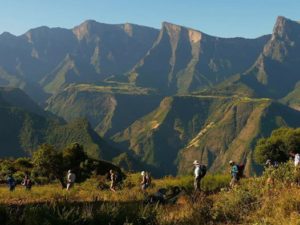
No matter how you look at them, the Simien Mountains will leave you speechless. For trekkers, silence is the result of their lungs screaming after slogging up a scree slope for 4200m. For animal-lovers, it’s the trepidation of sitting among 100 gelada baboons that zaps their vocabulary. For everyone with a heartbeat, it’s simply standing atop a panoramic precipice and overlooking the Abyssinian abyss that takes the breath away.

Guide

Be it a two-day stroll to Sankaber, or a five-day jaunt to Chenek or ten-day trek to Ras Dashen (4543m), with Simien Tours you will have the experience of a lifetime. With the the best possible guides and the best possible equipment, you can count on us for the following activities:

The leading force behind Simien Tours is our Ethiopian guide Masresha Teshager. As a child he grew up in "Limalimo village", with Limalimo being the famous mountainous road built by the Italians during the first quarter of the 19th century. The village is found 5 km away from Debark town to the north-east direction. It is now part of the Simien Mountains National Park as it is a very impressive place with plenty of plant species and wild animals. Masresha then went to Gonder to teach himself everything there is to know about the geography & animals of the Simien Mountains. He is now quickly becoming one of the most respectable guides around. You can count on his large network of friends, be it village chiefs in remote areas where, if you dare so, you can be the first white man, or be it a cook who can make the best European food if your stomach doesn't agree with Injera.

With Simien Tours, you will be in good hands. Enquire for a tour now on our Tours page.

Simien Mountains

Go into the Simien Mountains today, you will never forget the experience. The Simien Mountains without a doubt rank among the most spectacular mountains in the whole of Africa. The Gelada baboons will welcome you into their territory, and you will be their best friend. You can feed them grass like a horse, because they are the only primates that eat grass. In addition, you'll see a lot of other animals and birds. Take for example the lammergeyer. He's constantly circling high above the Simien Mountains, looking for its next prey, like rabbits. When the rabbit sees the lammergeyer, the rabbit runs away to its hole. Then the lammergeyer ignores that rabbit, and looks for another prey. It's the right of the fittest in its purest form, even for humans. The people live in small villages, sometimes tens of miles away from the nearest town. Sometimes they go selling something on the markets, like livestock, which they bring all over the Simien Mountains, along small and steep paths which have been used for ages by their ancestors. The closest town to the Simien Mountains is Debark. In Debark you can buy vegetables and other stuff that you need during the tour. In Debark you can also hire tents, sleeping bags and mattresses (it can be very cold in the Simien Mountains). Another town where you can stock up for the Simien Mountains is Gondar. Gondar is a bigger town, so in general it's cheaper, especially when you go to the supermarket. But beware: Gondar is also a very dangerous town, with lots of scammers and thieves. Like your mother always told you when you were a little kid: never go there with a stranger. You could end up losing a lot of money there. Luckily, once you arrive in the Simien Mountains, you don't need to worry about scammers. In fact, the people in the villages are very friendly, as we are.

Jeb Cobliss: I made a tour into the Simien Mountains with Simien Tours back in April. I always wanted to visit the Simien Mountains, so I went to their website, simientours.com, and ordered a tour. In Gondar, we were very well received, with warm applie pie and Ethiopian coffee, and then we had a ride by Jeep to the Simien Mountains. We got off just past the park entrance, and noticed that there were almost no tourists. A donkey was waiting for us, to carry all our luggage. The start of a real adventure...

  • Day 1: Gondar - sankaber camp. Drive to the first camp (sankaber) via debark (the small town) you will be rewarded with very impressive views of the low land areas to the north and west you will see most certain encounter troops of the endemic gelada baboons whilst in the simien mountains the gelada baboon only found in Ethiopia, is often referred to as the bleeding heart baboon or the lion monkey their coat is shaggy resembling a lion whilst their chest has a marked red heart or patch the gelada baboon can be found in good numbers are quite easy to approach. Sankaber camp is situated at an altitude of 3250 meters on an impressive view point between the northern escarpment and the southern wazla.before you arrive the camp you have about 2hrs. Walk. Meals included. 1 breakfast, 1 lunch, 1 dinner.
  • Day 2 /Sankaber- Gich. From Sankaber Camp the path to Geech Camp will stretch for approximately ten kilometers.(5-6hrs). The initial stages of this path leads through extensive areas of highland grasslands and heather forests. This path offers some of the most impressive views of the escarpement. One of the best views is of the Jinbar Wenz waterfall which plummets down the Geech Abyss. After descending down to the Jinbar Wenz River a short ascent remains to Gich village. In this area, cultivation is done in a two-year cycle. One side of the valley is planted whilst the other side lies fallow. You will notice extensive soil erosion in this area as a result of the combination of such factors as slope steepness, cultivation, overgrazing, erosive rainfall and limited land resources. We pause in Gich village as we are invited into one of the local houses for a coffee ceremony. Here you will participate in this very important social tradition of Ethiopia as well as gain an insight into the traditional lifestyle. Just above Gich village is the campsite which will serve as your base for two nights. The campsite has great views of the mountains and is characterised by giant Lobelia plants. These plants can grow up to 10 metres in height and may live for as long as twenty years, at which point they first flower before dying. Meals included: 1 breakfast, 1 lunch, 1 dinner
  • Day3.Walk from Gich to the three stanning palces namely Immetgogo,Saha, and kedadit and then walk back to Gich camp ,over night here.
  • Day4.Geeh-Cheneck. Walk from Gich to Cheneck via Immetgogo.If you are luck you migt see the Ethiopian wolf. time taken to complete this hike is about 7-8hrs and then over night here at Cheneck.
  • Day 5: Chenek-Sona via Buahit.The trek from Geech to Chenek covers approximately twelve kilometres (six to seven hours), following a path along the escarpment edge. Just before arriving into Chenek you will encounter the Kurbet Metaya viewpoint at 4070 metres - this viewpoint is actually a gap in the precipitous cliff - which reveals impressive views of the steep mountain faces to the west and the lowlands areas to the left.. The tightly clustered houses (tukuls) that form the village of Dihwara , tucked below a cliff, are also visible from this viewpoint. Chenek campsite is spectacularly located in a beautiful valley at the foot of the B wahit Peak . Strategically placed benches allow for the opportunity to take in the expansive views back toward Imet Gogo, especially beautiful in both the dawn and dusk light. A large troop of gelada baboons are common here and Walia Ibex are also often seen on the rocky escarpement edges here. Meals included: 1 breakfast, 1 lunch, 1 dinner
  • Day6: Sona- mekarebia. To day is the lowland area walk from sona camp the path to mekarebia camp via lamo river from the camp 1000m. will be faced with a two-hrs ascent to the lamo river at the river you take your time swimming and washing some clothes is possible and after you can have your lunch here and then two- hrs to the camp totally including the break is about 6hrs.mekarebia camp is at an altitude of (2200metres). Meals included: 1 breakfast, 1 lunch, 1 dinner.
  • Day7.Mekarebia-Mulit. To day is the warmer day from mulit camp we walk to mekarebia across derek wenz river here is also the very good swimming pool you can swim and after the river about 1 hour walk going up to awaza village and then all the way to the camp is mostly flat totally it is about (6-7hrs) walk.mulit is at an altitude of (2000metres). Meals included 1breakfast 1 lunch 1dinner.
  • Day8.Gondar via adiarkay. A final trekking day of the sensational simien mountains. Time taken to get the road to meet the jeep is about 1 and half hours. Once met the jeep ,drive straight to Gondar !

Practicalities about the Ethiopian Mountains

  • Never leave any trash in the mountains, give it to your guide.
  • The Simien Mountains are populated by traditional village people, respect their culture.
  • The Ethiopian Mountains, and especially the Simien Mountains, are home to some rare species, don't shoot them.
  • Ethiopia is a poor country, and especially in the Simien Mountains, people are sometimes desperate for your money.
  • Never trek the Ethiopian Mountains alone, always hire a licensed guide.
  • The mountains of Ethiopia are sometimes quite high, especially the Simien Mountains. Make sure that you are in good physical shape before you leave your country.
  • Some of the mountains in Ethiopia are quite high, altitude sickness is something to consider. Don't walk too fast; if you feel bad, stop for a moment and take a rest.
  • Bring plenty of sun lotion, the sun is very strong here because of the higher altitude.
  • On the other hand, at night, it gets very cold. Bring a sleeping bag that can handle temperatures below zero.